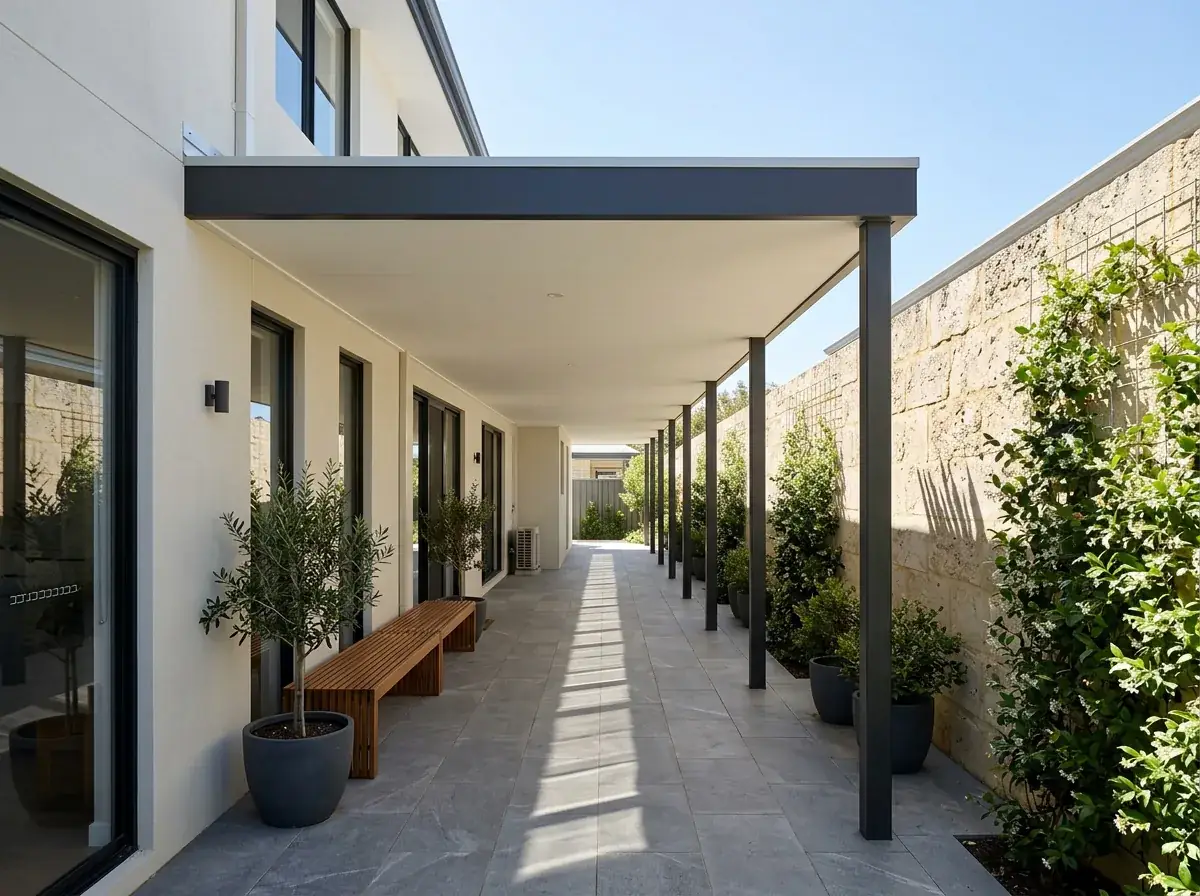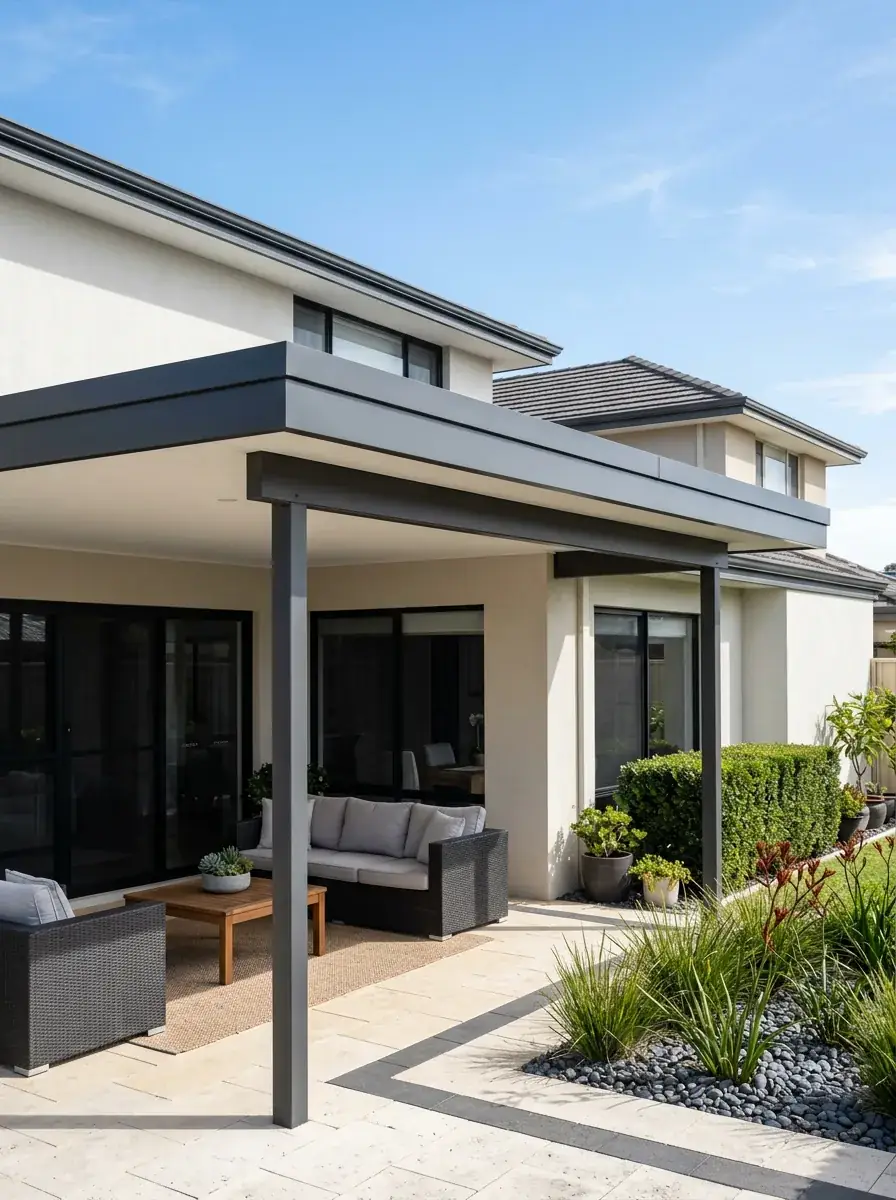
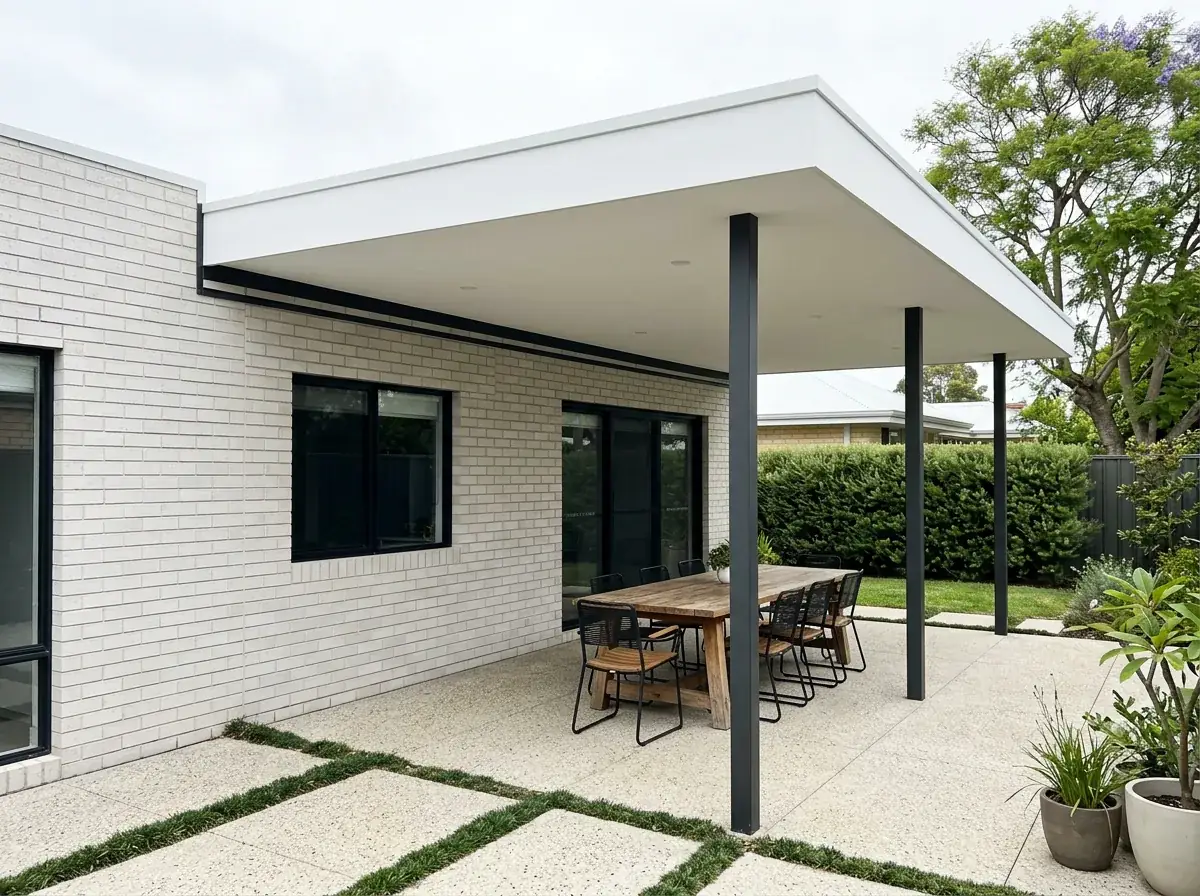
It is the cheapest of the four roof options we build and the widest in colour choice. It also has the most honest drawbacks. It gets hot, it drums in rain, and you look up at the steel holding it there.
None of that makes it wrong. It makes it a choice with conditions attached, and this page sets them out.
What Colorbond actually is
Colorbond is not paint on plain steel. It is a layered build: a steel base, a metallic zinc and aluminium alloy coating over that, a chemical pre-treatment, a corrosion-inhibiting primer, then a baked-on topcoat.
The alloy layer under the paint does most of the anti-corrosion work. Graze the topcoat while you are handling a sheet and the steel does not immediately begin rusting through, because that layer keeps protecting the mark.
The topcoat itself carries solar reflectance technology across most of the colour range. It reflects more heat than the same colour in an ordinary coating. On a flat roof sitting low over paving, that counts for more than it does on a pitched roof three metres higher.
Profiles, and how flat each one will go
Three profiles cover almost every flat patio in Perth. Classic corrugated, a trapezoidal ribbed sheet such as Trimdek or Monoclad, and a concealed-fix profile like Klip-Lok.
Minimum pitch is what separates them on a flat roof. Corrugated needs the steepest fall of the three, trapezoidal ribs run noticeably flatter, and concealed-fix profiles go flattest of all because there are no exposed fasteners or end laps for water to work back through.
That has a consequence at the house end. More fall means more height where the roof meets the wall, and on a single-storey home with a low fascia that height is often the thing you have least of.
Appearance follows function here. Corrugated reads traditional and matches most older Perth roofs, a wide rib reads flatter and more current, and concealed-fix gives you a plane with no line of screws across it.
- Corrugatedfamiliar look, most fall required, closest purlin centres
- Trimdek or Monocladflatter, wider purlin spacing, contemporary line
- Klip-Lokflattest of the three, no exposed fixings, higher sheet cost
Purlins, spans and what you see from underneath
Single-skin steel carries almost nothing by itself. It needs purlins under it at regular centres, and the deeper the rib in the sheet, the further apart those purlins can sit.
In 0.42 mm base metal thickness, corrugated generally wants support somewhere around every 1.2 to 1.7 metres. A deeper trapezoidal profile stretches that toward 2.1 to 2.4 metres, and a heavier 0.48 mm gauge pushes it a little further again.
So the profile you choose is really a decision about the ceiling. Under corrugated you look up at a ladder of steel every metre and a bit. Under a wide rib you see roughly half as many members.
Treat those figures as a starting point rather than a specification. Wind classification, sheet run and end conditions all move them, and the engineer sets the final centres for your address.
Colours, and how Perth homes actually pick one
The Colorbond range runs well past twenty colours. Perth flat patios cluster into about seven of them: Monument, Basalt, Woodland Grey, Surfmist, Shale Grey, Dune and Windspray.
Two matching strategies work. Match the house roof so the patio reads as part of the building, or match the window frames and gutters so it reads as a deliberate addition in the same family of colours.
Dark is the fashion and it carries a cost. Monument on a flat roof two and a half metres above paving soaks up a great deal of afternoon heat. Surfmist in the same position does not.
The trims do not have to match the sheet. A Surfmist roof with Monument gutter, fascia and posts is a common Perth combination: cooler underneath, still dark from the garden.
Heat under a single-skin steel roof
Single-skin steel has no insulation and almost no mass. Heat the top of the sheet and the underside is radiating it straight back down at you within minutes.
On a south or east-facing patio that is manageable. On a west-facing one in February it decides whether the space gets used at all after about two in the afternoon.
Three things fix it, and none of them is a different steel profile. Line the ceiling and insulate above the lining, screen the western end with battens so the low sun never touches the underside, or move to an insulated panel and stop the heat at the roof.
If the patio is your main seating and dining area, read the SolarSpan and Cooldek pages before you commit to single skin. The honest comparison is worth ten minutes.
Rain noise, expansion tick and the winter drip
Steel drums. A hard Perth downpour on a bare Colorbond patio roof is loud enough to stop a conversation, and that is not a fault in the installation.
Expansion noise is the second one. Steel moves with temperature, so a long run of sheet ticks and cracks as it heats through the morning and again as it cools after sunset. Correct fixing reduces it, and nothing removes it.
Condensation is the one nobody warns you about. On a clear winter morning the underside of a cold steel sheet can drop below dew point and drip, which is why a bare roof over a table occasionally rains on it at seven in the morning.
Lining the ceiling hides that drip without stopping it, because the moisture still forms on the steel above the lining. Insulation bonded directly to the sheet is what actually stops it.
Coastal Perth: salt, grades and washing
The coast changes the specification. Within roughly a kilometre of breaking surf the airborne salt load climbs sharply, and standard Colorbond is not the right grade for the closest sites.
Colorbond Ultra exists for exactly that. Same paint system, heavier metallic coating underneath it, and the sensible call for a patio at Scarborough, City Beach, Mullaloo or anywhere the sea breeze carries spray onto the roof.
Rain washing matters as much as grade does. Any part of a coastal roof that never gets rained on holds salt, so sheltered undersides, gutter beds and the back faces of trims want an occasional hose down.
Swarf is the avoidable failure. Drilling and cutting steel throws hot filings across the sheet, and every one left behind rusts into the paint and stains it permanently. Sweeping the roof down before the crew leaves is not optional on our jobs.
Fixings, flashings and where the water goes
Roof screws go through the crown of the rib with a bonded EPDM washer, at the pattern the wind classification calls for. Edge and perimeter fixings sit closer together than field fixings, because uplift concentrates at the edges of a flat plane.
The house junction is where flat patios leak, not the middle of the roof. Flashing goes under the existing tiles or sheets and is dressed properly. Sealant smeared over the top of an existing roof is a repair job waiting to happen.
The gutter takes a whole roof plane arriving at once. Perth rain comes in short hard bursts, so a wide Colorbond patio usually wants a deep gutter profile and two downpipes rather than one working alone.
From the downpipe it goes to a soakwell on your own block, sized for the new roof area. No Perth council accepts a patio discharging into the neighbour's yard or over the kerb.
Where Colorbond is the right roof
It is the right roof for a carport-style cover, a drying area, a roof over a caravan or boat, a shaded side walkway, or a patio you mostly use in the morning and through the cooler months.
It is also right when the budget has to stretch across a larger footprint. Covering the area you actually need in single skin beats covering two thirds of it in insulated panel.
It is the wrong choice for a west-facing entertaining area you intend to use all summer, and for anyone who wants a clean lined ceiling but would rather not pay for the roof twice.
It is also the wrong choice under a very low eave in a corrugated profile. The fall that profile needs may simply not fit inside the height you have to work with.