On a flat patio it earns its place doing one job well. Getting light past the new roof and into the rooms behind it.
Used as the entire roof over a Perth entertaining area, it usually disappoints. Clear sheet is hot, all of it is loud in rain, and it ages faster than steel does.
What polycarbonate roofing sheet actually is
It is an extruded thermoplastic, not fibreglass and not acrylic. The difference matters because polycarbonate takes an impact that would shatter the other two, and it stays flexible enough to be rolled into a roofing profile.
Every sheet worth buying has a co-extruded ultraviolet protective layer on one face. That layer is what stands between the sheet and the Perth sun, and it is only on the weather side.
Which is why the protective film is printed. Install a sheet upside down and it looks fine for two summers, then yellows and goes brittle years early. It is a genuine installation error and we check it on every sheet.
Corrugated sheet or multiwall panel
Corrugated and trapezoidal polycarbonate is rolled to match common steel profiles. That is the whole point of it on a flat patio, because a matched sheet laps straight into the Colorbond either side of it and the roof stays one continuous plane.
Multiwall is a different product. Twin or triple-wall panels in 10, 16 or 25 mm sit in aluminium glazing bars, insulate far better than a single skin of plastic, and diffuse the light instead of throwing a hard shadow.
Multiwall costs more and does not lap into a steel roof, so it usually appears as a complete small roof over a courtyard, a walkway or a deck rather than as an insert.
For most Perth flat patios the profiled sheet is the right answer. Multiwall is worth pricing when the polycarbonate is the whole roof and you want to take the edge off both heat and glare.
Tint and light transmission: the choice that decides everything
Light transmission runs from around 90 per cent on clear sheet down to roughly 10 per cent on the heat-reducing tints. That is a very wide range, and picking from a brochure swatch is how people get it wrong.
Clear passes heat as freely as it passes light. Over a paved Perth patio in February, clear sheet gives you glare underfoot and radiant heat overhead, and the space can feel worse than standing in the open.
Opal and diffused grades are the usual recommendation. They scatter the light so you get brightness without a hot spot travelling across the paving all afternoon, and they hide dust and leaf shadow far better.
Grey, bronze and the infrared-reducing grades cut solar heat gain hardest. They also make the space under them dimmer, which defeats the purpose if the whole reason for the sheet was daylight into a back room.
- Clearmaximum light, maximum heat and glare, rarely the right call in Perth
- Opal or diffusedeven light, softened shadows, the safe default
- Grey or bronzecooler underneath, noticeably dimmer
- Infrared-reducing gradesbest heat performance in a translucent sheet
Where polycarbonate belongs on a flat patio
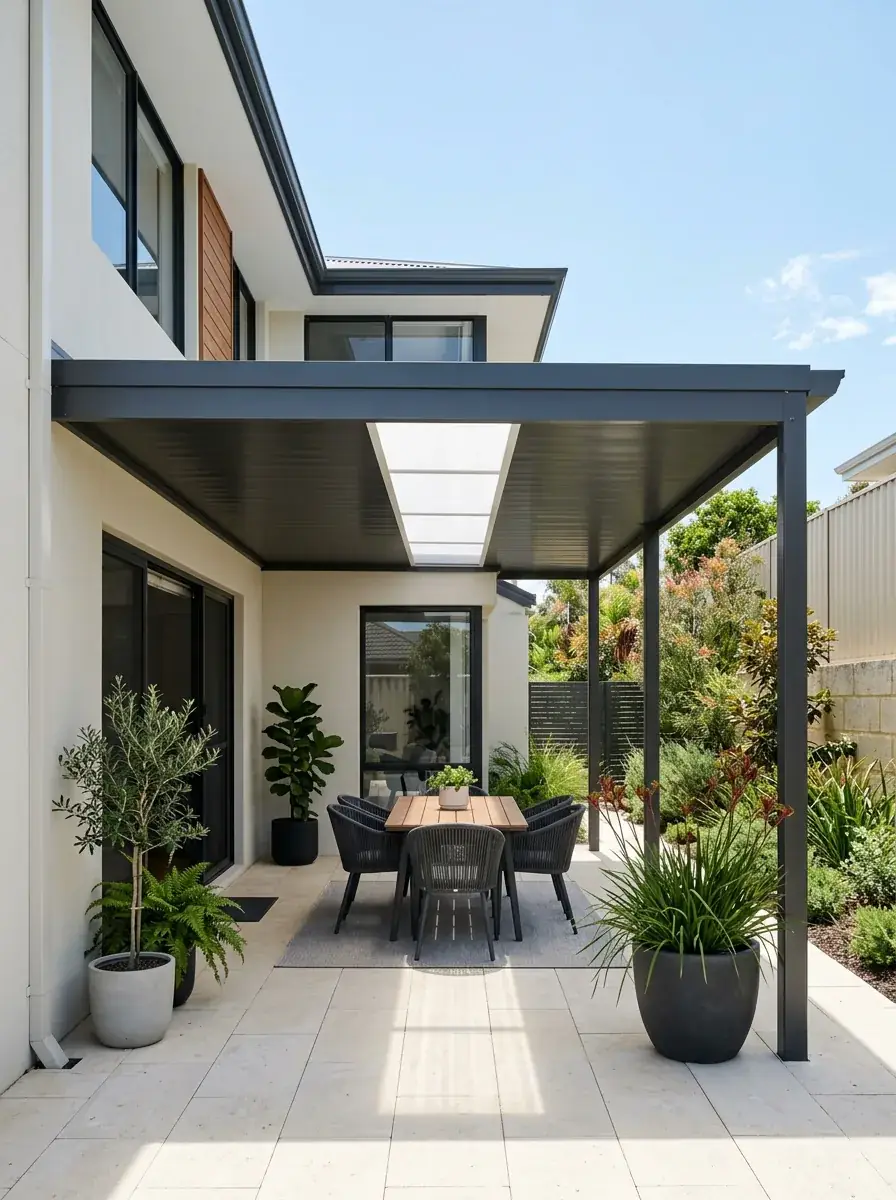
The strongest use is a daylight strip along the house wall. One or two bays of translucent sheet where the patio meets the building, keeping light into the kitchen or living room while the seating area stays under solid roof.
The second is a small roof where light matters more than heat. A side walkway, a drying court, a narrow south-facing courtyard, or a cover under a first-floor balcony that would otherwise put the rooms below into permanent shade.
The third is a staged budget. Sheeting a section in polycarbonate now and replacing it with steel or panel later is straightforward, provided the supports were set out at the closer centres from the beginning.
What it is not good at is being the whole roof over the table. That is the job people most often ask it to do, and the one it handles worst in a Perth summer.
Thermal movement, and why the fixing holes are oversized
Polycarbonate moves a lot. It expands and contracts roughly ten times as much as steel for the same temperature change, in the order of 0.065 mm per metre per degree.
Put real numbers on that. A six metre sheet swinging from a cold winter night to a black-hot summer afternoon can move something near twenty millimetres along its length, and that movement has to go somewhere.
So the fixing holes are drilled oversize, deliberately, several millimetres larger than the screw shank. Purpose-made polycarbonate screws with large bonded washers then hold the sheet without clamping it.
Over-tightening is the classic failure. Nip a screw down hard on polycarbonate and you have created a fixed point in a moving sheet, and the crack that starts at that hole in year two is not a warranty claim.
Rain noise, hail and honest expectations
It is the loudest roof material we install. The sheet is thin and light, so there is nothing to absorb the impact, and rain on polycarbonate is louder than the same rain on Colorbond.
Some people like it. A lot of people do not realise how loud it is until the first proper winter front comes through, which is another argument for using it as a strip rather than a whole roof.
Hail is more interesting. Polycarbonate has very high impact resistance while it is young, considerably better than glass or acrylic, and Perth hail rarely troubles a new sheet.
That resistance falls away with age. An old, ultraviolet-degraded sheet is brittle, and the same hailstone that bounced off it when it was new will punch through it.
Supports, fall, and why you cannot walk on it
Polycarbonate needs far more support than steel. Profiled sheet typically wants purlins or battens somewhere around 600 to 900 mm apart, closer again at the ends where the sheet is most exposed to uplift.
Minimum fall generally follows the steel profile the sheet imitates, and the same rule applies: build flatter than the published minimum and water sits in the laps. On polycarbonate that shows as a permanent dirt line you cannot scrub out.
Access is the safety issue. Polycarbonate is non-trafficable, full stop, and falls through fragile roofing are one of the more common serious incidents on Australian sites.
So plan for it now. If a gutter above a polycarbonate section will ever need clearing, the roof needs safety mesh under the sheet or a set-out that lets someone work from a ladder or a crawl board instead.
Ageing, yellowing and how to clean it
Every polycarbonate sheet slowly loses light transmission and slowly gains brittleness. Good ultraviolet-protected sheet from a known brand does it slowly enough to carry a long written warranty against yellowing.
Cheap sheet does it fast. Perth sits under a high ultraviolet index for a large part of the year, and unbranded or thin sheet can visibly yellow within a handful of summers.
Cleaning is where people damage it. Warm water, mild detergent and a soft cloth or a soft broom, rinsed off before it dries.
Never use solvents, ammonia-based cleaners or anything abrasive. They craze the surface into a fine web of cracks that never comes out, and a pressure washer at close range will do the same to the protective layer.
Where polycarbonate is the right roof
It suits anyone whose real problem is a dark room. If the new patio roof will block the only northern light into a living area, a couple of bays of opal sheet solves that for a fraction of what a skylight in the house roof costs.
It suits narrow, shaded, secondary spaces. Side paths, drying areas, courtyards between two buildings, and covers under balconies where light is scarce and nobody sits for hours.
It is the wrong choice for the main entertaining area, for a west-facing aspect, and for anyone sensitive to noise. It is also the wrong choice on a roof you will need regular access above.
If you want both daylight and a comfortable summer, the usual answer is an insulated panel roof with a single polycarbonate bay in it. You get the ceiling, the heat performance, and the light exactly where it is needed.