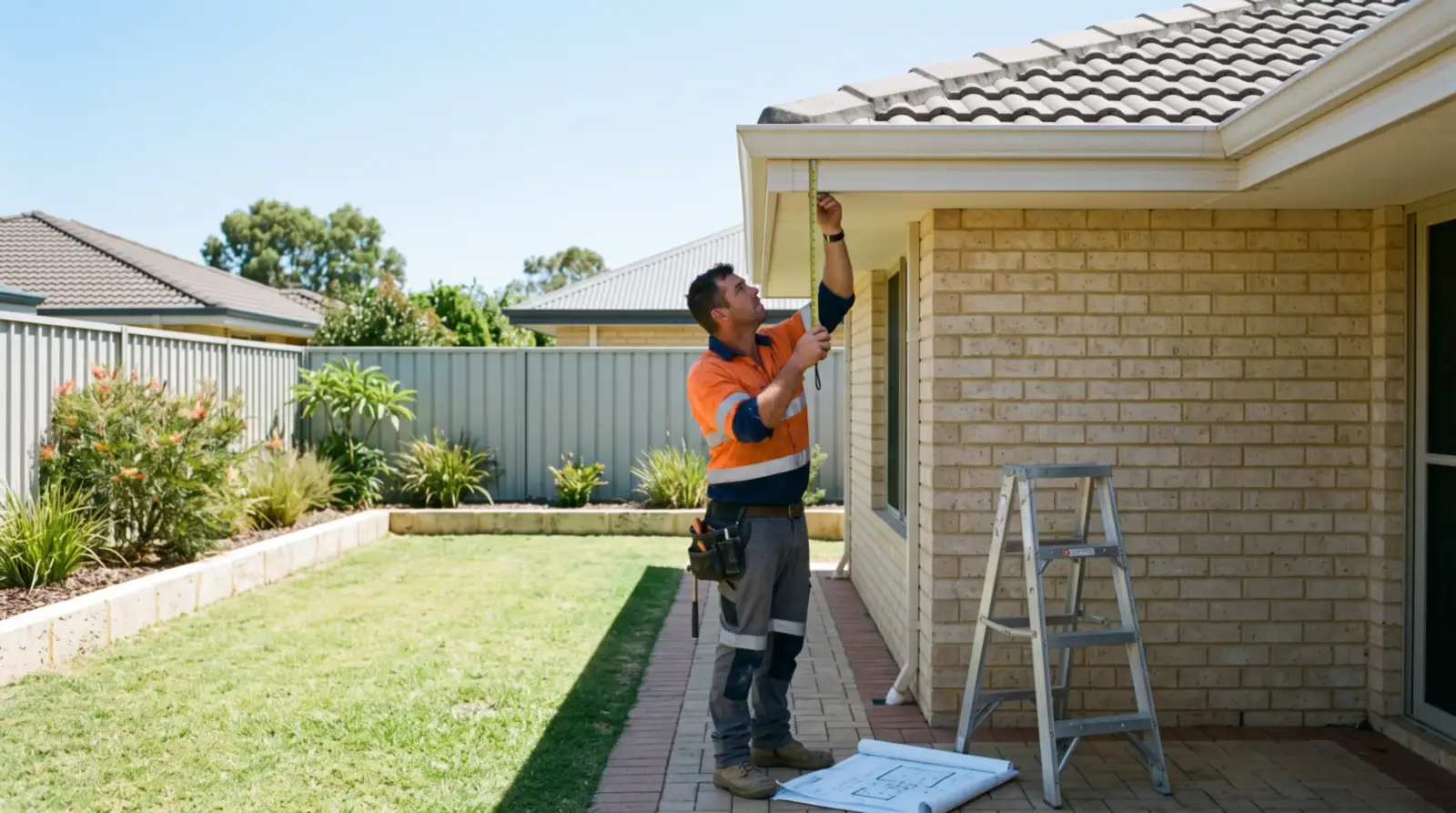
The short version
Patio cleaning on a flat roof takes less work than most people expect, but it has to happen in the right places. The top sheet is washed by rain; the underside, the gutter and the posts are not, and COLORBOND's own guidance names the underside of patios as an area to hose down at least every six months, more often near the coast. Use clean water, a mild detergent and a soft brush, never abrasives or solvents, and keep the gutter and soakwell clear so the roof can keep draining.
What catches people out is where the dirt sits. The top of the roof gets washed every time it rains, and the parts you look at from your chair never do.
This guide covers what to clean, how often in Perth, what to use and what to avoid, and the signs that mean it needs a builder.
Which parts actually need cleaning
Rain does most of the work on top. Water running down the slope to the gutter, called the fall, carries dust and pollen off the sheet, so the upper surface largely looks after itself.
The underside is another story. COLORBOND calls these "unwashed areas", parts of a building that rain never reaches, and it lists the underside of patios and carports among them by name.
So the ceiling you sit under, the beams, the gutter's outer face and the posts are where dust, cobwebs and salt build up. That is where your cleaning time goes.
- Underside of the roof sheet or panel ceiling
- Beams and the inside face of the gutter
- Posts and the base plates at ground level
- The flashing line where the patio meets the house

How often to wash it in Perth
COLORBOND's guidance is to hose unwashed areas down at least every six months. That suits most Perth suburbs, and an easy way to remember it is once before winter and once before summer.
Near the coast, wash more often. Salt spray carries further inland than people think on a strong sea breeze, and COLORBOND advises more frequent washing where marine salt spray is common, every three months in the technical bulletin.
Trees change the timetable too. A patio under a jacaranda, a peppermint or a gum collects leaves and sap far faster than one in open sun, and needs the gutter cleared more than twice a year.
Free site measure
Every figure on this page changes once someone looks at your fascia, your slab and where the water goes. That visit costs nothing.
What to use for patio cleaning
Keep it gentle when cleaning a Colorbond roof. The coating is tough, and it lasts longest when nothing harsh touches it.
Hose the surface first to lift loose dust, wash with the solution below, then rinse off every trace of soap with clean water.
- Clean, fresh water from a garden hose
- A mild solution of pure soap or non-abrasive dishwashing detergent in warm water
- A sponge, soft cloth or soft-bristle nylon brush on an extension pole
- A final rinse with clean water so no soap is left to dry on the steel
What to keep away from the roof
Most damage to a patio roof during cleaning comes from harsh products or too much pressure. The coating is what protects the steel underneath, and scratching it is the one thing you cannot rinse away.
COLORBOND's guidance is a hose, mild detergent and a soft brush. A high-pressure cleaner is not part of it, so if you use one at all, keep it well back on a wide fan and never aim it at the laps where sheets overlap, the flashings that seal the joins, or cut edges.
- Abrasive cleaners, scourers and steel wool
- Solvents such as turps, petrol, kerosene or paint thinners
- Stiff wire brushes on painted steel
- Leaning ladders, tools or furniture against the sheet edge
Cleaning the underside
Under the patio is where the cleaning is most visible. Cobwebs gather in the corners of the beams, and dust settles on the underside of a single-skin roof between the ribs.
If you have an insulated panel ceiling with downlights or a fan, turn the power off at the switchboard before you wet anything. Wash around fittings with a damp cloth rather than a hose.
Work from the house side out towards the gutter, so dirty water runs away from the wall rather than down it.
Still deciding
You do not have to have settled on anything to book a measure. Most people use it to find out what their block will actually take.
Gutters and the soakwell
A flat patio drains to one gutter, so that gutter matters more than any other part of the roof. When it fills with leaves, water backs up onto the low edge of the sheet and sits there.
Clear it before winter and after any big wind. Flush each downpipe with the hose to make sure it runs freely, and look at where it discharges.
Every few years, lift the lid on the soakwell, the buried pit your downpipe drains into. Soakwells silt up slowly, and a full one pushes water back up the downpipe long before anyone notices. Our guide to how a flat patio handles Perth rain explains how the whole system fits together.
Stay off the roof
Clean a patio roof from a ladder, never from on top of it. Roof sheeting and insulated panels are not made to be walked on between their supports, and a footprint can dent a sheet or crack a panel skin.
Set the ladder on firm, level paving, not on a soft garden bed, and have someone hold it. Reach the top surface with a brush on a pole from the gutter line.
If the gutter can only be reached by getting onto the roof, that is a job for someone with the right equipment.
Keep soil, mulch and leaves off the steel
COLORBOND warns against any build-up of debris such as soil and mulch against its products. Damp material held against the steel keeps the coating wet for weeks at a time.
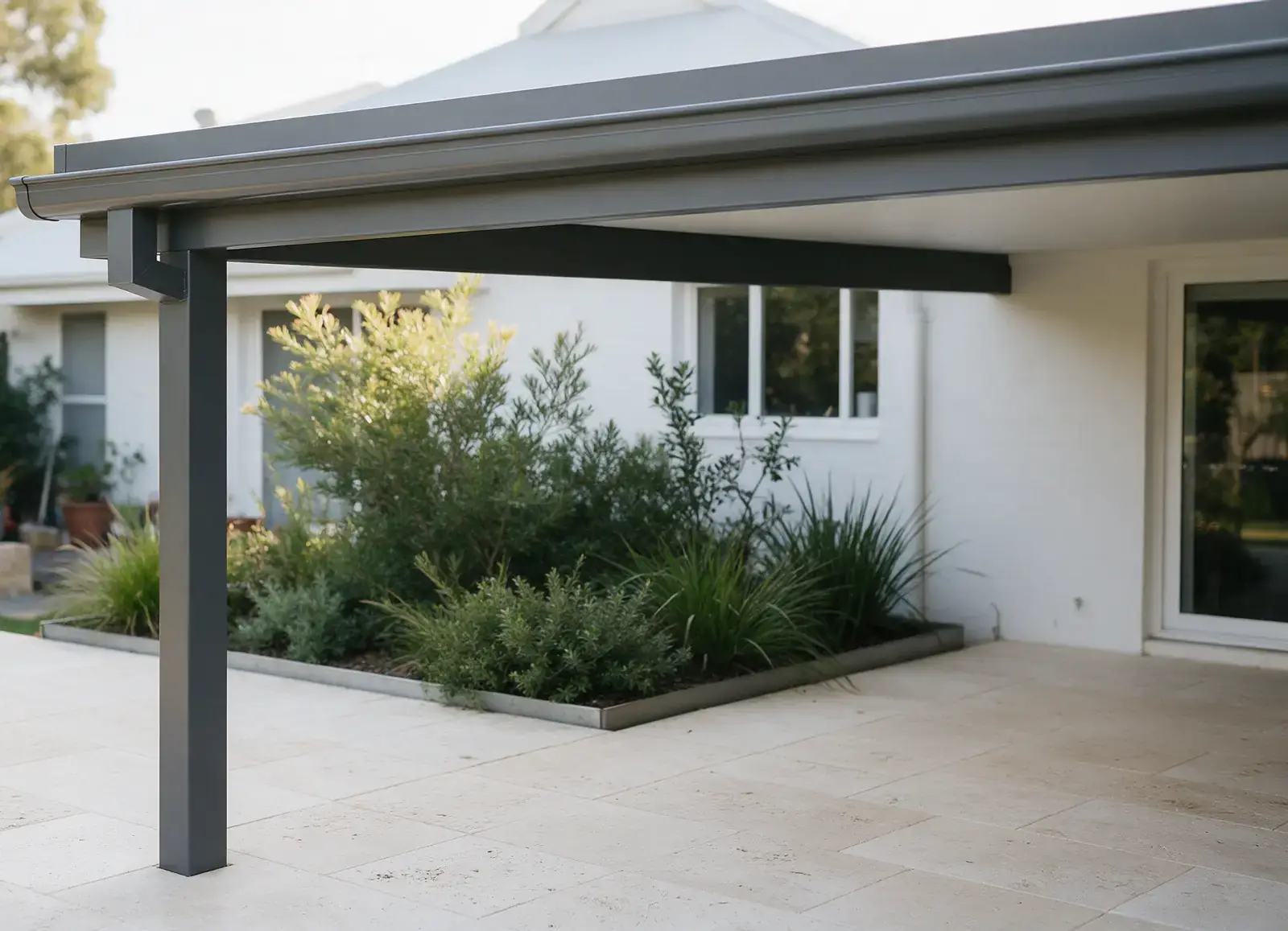
On a patio, that usually means the posts. A garden bed built up around a post base, or mulch piled against it, is the most common place a patio starts to look tired at ground level.
Keep a clear gap around each post and sweep leaves out of the corners where the gutter meets the beam.
Talk to the experts
If you would rather ask than read, ring us. Most of what is on this page takes about a minute to cover on the phone.
Signs it needs a builder
Cleaning keeps a sound roof looking right. It will not fix a roof that has a problem, and some problems get worse the longer they are left.
If you see any of these, have it looked at. Our patio repairs team checks the fall, the fixings and the flashing, and tells you whether it is a repair or something bigger.
- Water still sitting on the roof a day after rain
- A drip or a stain where the patio joins the house
- A beam or the roof edge that has started to sag
- Dents, deep scratches or bare metal showing on the sheet
- Fixings that rattle or have worked loose after a storm
A simple year for a Perth patio
Put it in the calendar and it takes two short sessions a year, with a quick check after big weather.
- Autumn, before the winter rainclear the gutter, flush the downpipes, wash the underside
- After a big wind or stormcheck the gutter, the fixings and the house join
- Spring, before summerwash the underside, posts and beams again
- Every few yearslift the soakwell lid and check it is not silting up
- Near the coastadd a wash in mid-winter and mid-summer